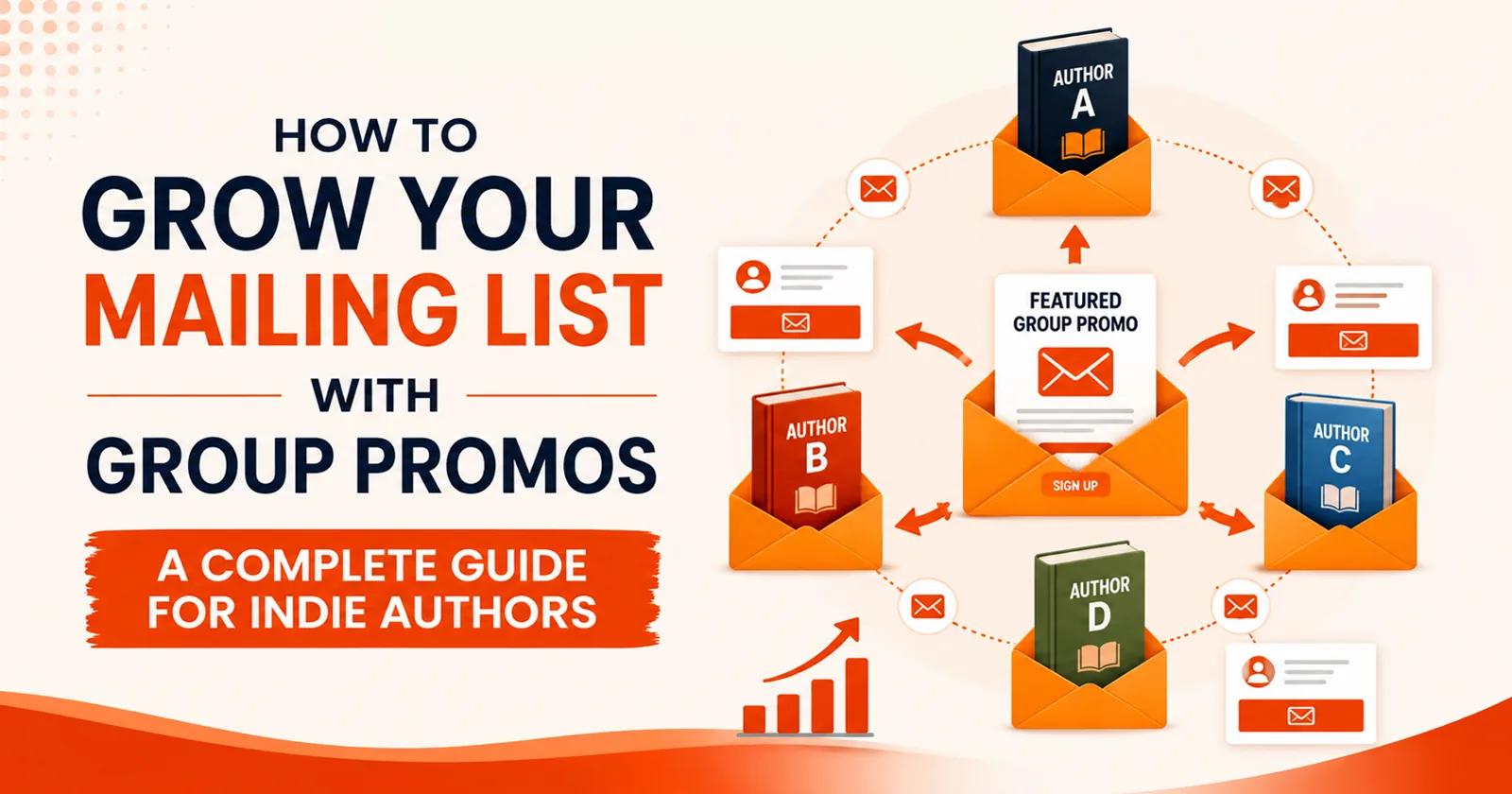
For indie authors building a sustainable publishing career, few marketing channels match the consistency and long-term value of email newsletter marketing. Unlike social media platforms whose algorithms decide who sees your posts, or paid advertising that demands a continuous budget, a well-cultivated mailing list is something you genuinely own. And it compounds in value with every reader who joins.
But here's what many newer authors miss: simply having a mailing list and sending occasional updates captures only a fraction of what email marketing can do for your book sales. An important multiplier is the book swap, also commonly known as a newsletter swap, a technique behind much of the consistent revenue generated by successful indie authors writing in genre fiction.
In this guide, we'll walk through everything you need to understand to start scaling your newsletter marketing with book swaps: what they are, how they work, the three primary types you can run, how to time them around your release for maximum impact, the common concerns authors have when getting started, and the practical challenges you'll face when running swaps at any meaningful scale.
By the end, you'll understand why book swaps are considered one of the most cost-effective marketing tools available to indie fiction authors today, and have a clear framework for using them in your own author business.
Why Your Mailing List Is Your Most Important Marketing Asset
Before getting into book swaps specifically, it's worth taking a moment to understand exactly why your mailing list deserves so much of your marketing attention in the first place.
The single most important characteristic of a mailing list, especially compared to other marketing channels available to authors, is ownership. Your mailing list is yours. The subscribers on it have voluntarily given you permission to email them, and that relationship exists between you and your readers. Not between you and a platform that could change its rules tomorrow.
Compare this to a Facebook page with 10,000 followers. That asset is, in practical terms, rented from Facebook. If your account gets suspended, if Facebook changes its algorithm to suppress organic reach (as it has done repeatedly), or if the platform itself declines in popularity, that audience can effectively disappear overnight. The same applies to TikTok followers, Instagram audiences, Twitter/X followings, and any other social platform where your relationship with your readers is mediated by a third party.
This isn't a hypothetical risk. Authors regularly lose access to social media accounts, watch their organic reach plummet after algorithm changes, or see entire platforms decline in cultural relevance. When that happens, the audience built on those platforms is gone with very little recourse.
A mailing list doesn't carry this vulnerability. The list itself is data you can export, back up, and migrate between email service providers. The relationship is direct.
The second major advantage is deliverability. When you send a newsletter, you can be reasonably confident your message will land in your subscribers' inboxes. They may not all open it, but you've reached them in a personal space where attention is at least possible. With social media, even if you post regularly, the algorithm decides what fraction of your followers will see any given post, often less than 5% of your audience, sometimes much less.
For an indie author trying to build a long-term career, these two characteristics (ownership and direct deliverability) make your mailing list the single most valuable marketing asset you can build. Every other channel is essentially a way to acquire new email subscribers. The list itself is the foundation.
What Is a Book Swap?
A book swap, or newsletter swap, is a mutual agreement between two authors to feature each other's book in their respective newsletters. You include their book in a newsletter going out to your subscribers, and in exchange, they include your book in a newsletter going out to theirs.
The premise is simple, but the implications for your reach are significant. Without book swaps, the audience for your newsletter promotion is limited entirely to your own subscriber list. If you have 1,000 subscribers, your book gets in front of 1,000 readers when you send your newsletter.
Now imagine you set up book swaps with 10 other authors in your genre, each with their own mailing list of 1,000 to 5,000 subscribers. Suddenly, your book is being promoted not only to your own 1,000 subscribers, but also to the combined subscribers of all 10 swap partners. Depending on the size of their lists, this could easily mean reaching 10,000, 20,000, or even more readers, all without spending a dollar on advertising.
This multiplier effect is the core reason book swaps have become such a foundational strategy in indie fiction publishing. Where paid advertising channels like Facebook Ads or Amazon Ads require ongoing budget and constant optimization to maintain results, book swaps are essentially free. The only "cost" is the reciprocal commitment to include the other author's book in your own newsletter.
There's also a quality dimension that paid advertising can't match: the trust transfer. When a reader sees a book mentioned in a newsletter from an author they already subscribed to and enjoy, that recommendation carries an implicit endorsement. The reader is far more likely to give your book a serious look than if they encountered the same book through a paid ad from a stranger.
This combination (significant audience expansion, near-zero cost, and built-in trust transfer) is what makes book swaps such a powerful marketing instrument. Used consistently, they can be the single most impactful organic growth strategy in an indie author's toolkit.
The Three Types of Book Swaps
When authors set up book swaps, there are typically three different formats to choose from. Each represents a different level of prominence in the newsletter, and each has its own use case depending on what you're trying to achieve and what you can offer in return.
Solo Send
A solo send is the most powerful type of book swap. In a solo send, your book is the only book featured in the partner's newsletter. No other books, no other authors competing for attention. The entire email is dedicated to introducing your book to the partner's subscribers.
Because the reader's full attention is on your book, solo sends consistently deliver the highest click-through rates, the most sample downloads, and the strongest sales spikes of any swap type. If you can secure solo send swaps, they should always be your first choice for major book releases or important promotional moments.
Feature
A feature swap places your book at the top of a newsletter that also includes one or more other books further down. You're not the only book in the newsletter, but you're the headliner. Your book gets the prominent placement, the larger graphic, and the primary call to action.
Features are still very effective. They give your book strong visibility while allowing the partner author to include other promotional content alongside it. They're a common middle-ground option, especially for swap partners who run curated, regularly-scheduled newsletters.
Mention
A mention is the lightest form of book swap. Your book appears further down in a newsletter that has another book featured at the top. You're getting visibility to the partner's audience, but you're not the headline act.
Mentions are still worthwhile: exposure to a relevant audience is exposure to a relevant audience. But the click-through and conversion rates will typically be lower than features or solo sends. They're a good way to build relationships with new swap partners or to fill in additional reach when your higher-priority swap slots are already booked.
How Swaps Are Typically Matched
The most common arrangement is to swap like-for-like: you give a solo send to receive a solo send, a feature for a feature, or a mention for a mention. This is the cleanest and most equitable arrangement, and it's where most swaps land.
However, the format also gives newer authors a useful negotiating tool. If your mailing list is still small, you may be able to set up swaps with much larger authors by offering an asymmetric trade: for example, providing a solo send in your newsletter in exchange for a feature or mention in theirs. The larger author still gets the dedicated attention of your audience (even if smaller), and you get the broader reach of theirs. Used thoughtfully, this is one of the better ways to punch above your weight when you're starting out.
Send Dates Don't Have to Match
One detail that surprises some authors getting into swaps: the two send dates of a swap don't have to be the same day. If your book releases this week and your partner's book releases next week, you might agree that they'll feature your book this week, and you'll feature theirs the week after. This flexibility is critical, because it allows both authors to align their swap sends with their own release schedules and promotional calendars.
Timing Your Swaps for Maximum Impact
If you're publishing on Amazon (which the majority of indie fiction authors are), timing your swaps strategically around your book's release can have a significant effect on how Amazon's ranking algorithm treats your book.
Amazon's bestseller rankings respond to sustained sales velocity. A single large spike in sales on release day will boost your ranking briefly, but that boost fades quickly if there's nothing to maintain the momentum. By contrast, consistent purchases across multiple consecutive days signal to the algorithm that your book has continued reader interest, and this prolonged signal often translates into a longer, more stable presence in genre rankings, also-bought recommendations, and Amazon's various organic discovery surfaces.
This is where strategic swap timing becomes valuable.
Rather than concentrating all of your promotional pushes on release day itself, experienced indie authors typically schedule a sequence of book swaps spread across the first 5 to 7 days following release. Each swap brings a new wave of readers to your book on a different day, keeping the sales velocity steady throughout your launch window. The result is a sustained signal to Amazon's algorithm that compounds into significantly better ranking outcomes than a single concentrated launch day would deliver.
If you're prioritizing which swap types to schedule during this critical post-release window, lead with solo sends. They consistently outperform features and mentions in terms of click-through and conversion, so the limited number of premium swap slots you can secure should be deployed where they'll have the most measurable impact. Features and mentions can supplement the launch sequence on days when solo sends aren't available, or extend your visibility into the second week.
A practical launch schedule might look something like this: solo send on day 1 (release day), feature on day 2, solo send on day 3, mention on day 4, solo send on day 5, feature on day 6, mention on day 7. The exact mix depends on what you've been able to arrange, but the principle holds: distribute the volume across days, prioritize solo sends when possible, and keep the signal to Amazon continuous.
Common Concerns About Book Swaps
Book swaps are a long-established and widely-used marketing tool in indie fiction, but they sometimes get a hesitant reception from authors who haven't tried them yet. The most common worry: "Won't all this extra promotional emailing damage my mailing list? Won't my subscribers start unsubscribing?"
It's a fair concern, and worth addressing directly.
The short answer is that, in general, your subscribers are happy to hear from you. They subscribed because they wanted to. Most readers who are actively engaged with a genre they enjoy are interested in finding new books in that genre. Which is exactly what a well-targeted swap delivers.
The longer answer acknowledges that yes, running book swaps will result in some unsubscribes over time. Every newsletter you send carries some unsubscribe risk. That's simply how email marketing works. But the math here is overwhelmingly favorable: in exchange for losing a small percentage of your existing subscribers, you're getting your book in front of an audience that can easily be 10 to 20 times larger than your current list. Even a small fraction of that expanded audience converting into new readers, new fans, and new long-term subscribers more than offsets the natural list attrition.
There's also an important quality dimension to this. The unsubscribes you receive from a well-targeted swap newsletter are typically people who were already disengaged from your list. Active, engaged readers are happy to hear about new books in the genres they love. The subscribers who unsubscribe because you featured another author's book were likely heading toward unsubscribing anyway. In some ways, swaps perform a useful function of clearing inactive subscribers off your list while introducing you to new, more engaged ones.
The authors who avoid swaps out of fear of losing subscribers tend to look back, a year or two later, and recognize that this caution was the single biggest growth opportunity they missed.
The Practical Challenges of Running Book Swaps at Scale
While the strategic case for book swaps is clear, actually running them well comes with a set of real practical challenges, especially as you scale up to multiple swaps per month. Understanding these challenges in advance will save you significant frustration.
Finding Genre-Aligned Partners
The single most important factor in swap effectiveness is genre alignment. A swap with an author whose readers love the same kind of books you write will outperform a swap with an author in an unrelated genre by an enormous margin, regardless of list size.
This sounds obvious, but in practice it requires genuine attention. A romance reader who subscribed to a contemporary romance author's list is unlikely to be the right audience for a fantasy adventure, even if the fantasy author has an excellent book. The mismatch results in low click-through rates, low conversions, and disappointment for both parties.
Effective swap setup means narrowing your partner search to authors writing in your specific subgenre, not just your broad genre category. The more aligned the audiences, the more effective the swap.
Verifying That Partners Actually Send
A second challenge is commitment fulfillment. When you agree to a swap, you're trusting the other author to actually include your book in their newsletter on the agreed-upon date. Most authors do follow through. But some don't, whether through disorganization, schedule changes, or simply not prioritizing the commitment.
When a swap partner fails to send, you've fulfilled your end of the deal (sending their book to your subscribers) without receiving the return promotion. Over time, encountering enough of these one-sided swaps can be both costly and demoralizing.
The most reliable way to mitigate this is to work through reputable swap platforms, like BookSparker, StoryOrigin, or BookFunnel, that bring transparency to the process. The best of these platforms not only display a partner's reputation and track record of fulfilled swaps, but ideally also surface actual sending data such as the number of recipients, the newsletter's open rate, and the click-through rate on your book's link. This kind of verification transforms book swaps from a trust-based handshake into a measurable marketing channel where you can see exactly what each partnership delivered.
Managing Many Simultaneous Commitments
The third major challenge, and the one that tends to catch authors off guard, is commitment management. Setting up 10 solo send swaps with 10 different authors sounds great until you realize you now have 10 different newsletter send dates to track, 10 different books to feature, and 10 different sets of promotional copy and links to coordinate.
This complexity multiplies if you're running swaps for multiple of your own books, managing multiple mailing lists (for different pen names or genres), or coordinating around your own ongoing newsletter content. Missing a single send date can damage your relationship with a swap partner, hurt your reputation in the community, and forfeit the return promotion you were counting on.
For occasional swappers, a simple calendar can be enough. But once you're running more than a handful of swaps per month, you'll want a dedicated system that ensures no commitment slips through the cracks. This can be a well-designed spreadsheet, a project management tool, or one of the swap-specific platforms mentioned above.
Putting It All Together
Book swaps are not a new or experimental technique. They are a long-established, widely-practiced strategy that consistently produces measurable results for indie fiction authors who use them thoughtfully.
The fundamentals are straightforward: build a mailing list that you own and control, then multiply its reach by setting up reciprocal newsletter swaps with other authors writing in your genre. Choose the type of swap (solo send, feature, or mention) that fits the moment and your relationship with the partner. Time your swaps strategically around your release dates to maximize their impact on Amazon's ranking algorithm. Accept that some unsubscribes are simply part of the process, and that the audience expansion they enable is well worth it.
The challenges, like finding genre-aligned partners, verifying that swaps actually get sent, and managing many commitments without missing a send date, are real, but they're solvable with the right combination of intentional partner selection, transparent platforms, and good organizational systems.
For an indie author serious about growing their readership without spending heavily on paid advertising, few marketing strategies offer the consistency, reach, and cost-effectiveness of well-run book swaps. They reward the authors who treat them professionally, plan them strategically, and use them consistently as a core part of their newsletter marketing approach, not as an occasional experiment, but as an ongoing engine of audience growth.
This guide is published by BookSparker, a platform built for indie authors to organize book swaps and group promos.